
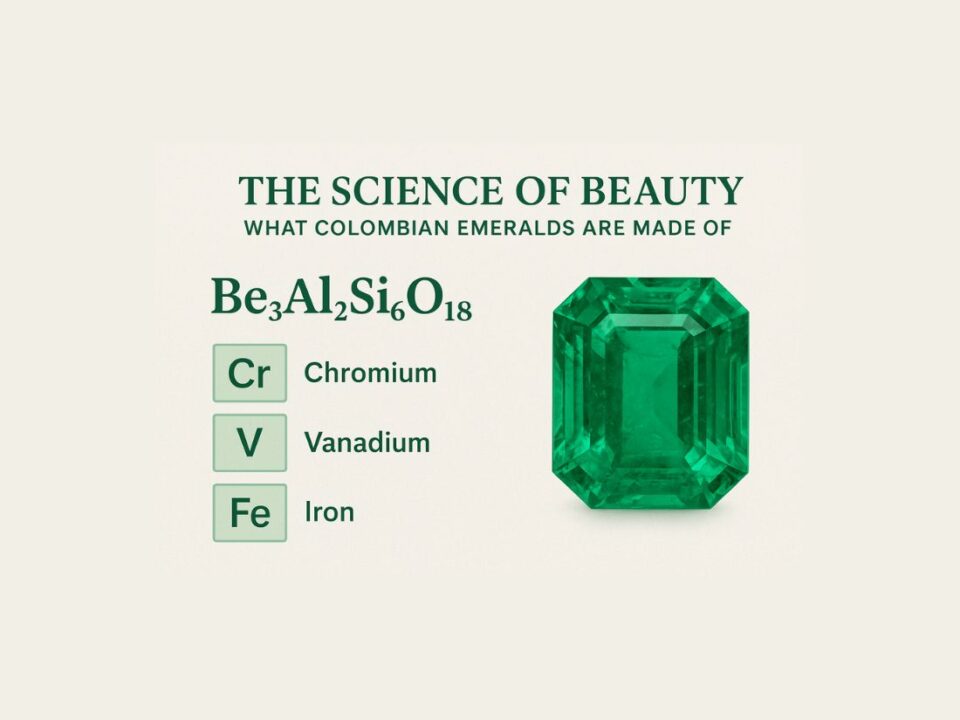
Behind every dazzling Colombian emerald lies a fascinating composition of elements that nature brought together under unique conditions. More than just a gemstone, an emerald is a chemical masterpiece millions of years in the making.
1. The Core Element: Beryllium
Emeralds belong to the beryl family, a mineral group composed primarily of beryllium, aluminum, and silicate (Be₃Al₂Si₆O₁₈). On its own, beryl is colorless—but when combined with trace elements, it transforms into vivid gems like aquamarine or emerald.
2. The Green Glow: Chromium and Vanadium
The lush green color that makes Colombian emeralds world-famous comes from the presence of:
- Chromium (Cr) → Produces the intense green with bluish undertones.
- Vanadium (V) → Adds vibrancy and depth to the color.
This unique combination is what separates Colombian emeralds from stones mined elsewhere. Brazilian emeralds, for example, often rely more on vanadium, while Zambian emeralds have stronger iron content.
3. The Role of Iron
Iron (Fe) is often present in emeralds but in higher amounts it can make the gem appear darker or even slightly bluish. Colombian emeralds are special because their iron content is usually very low, allowing their green color to appear pure, vivid, and bright.
4. Inclusions: Nature’s Signature
Alongside these chemical elements, Colombian emeralds often contain inclusions of calcite, pyrite, or tiny fluid-filled cavities. Far from imperfections, these inclusions are called jardín (“garden”) and serve as a unique fingerprint of authenticity.
5. More Than Chemistry: A Story of Rarity
It’s this rare combination of beryllium, chromium, vanadium, and low iron content that gives Colombian emeralds their legendary glow. They are not just minerals—they are nature’s alchemy, transformed into jewels that carry cultural, historical, and emotional value.
At Alpine Green, we carefully select emeralds with the finest balance of these elements, ensuring each stone reflects the purity and richness Colombia is known for.
👉 Next time you admire the glow of a Colombian emerald, remember: it’s not just a color—it’s chemistry, earth, and time captured in crystalline form.